
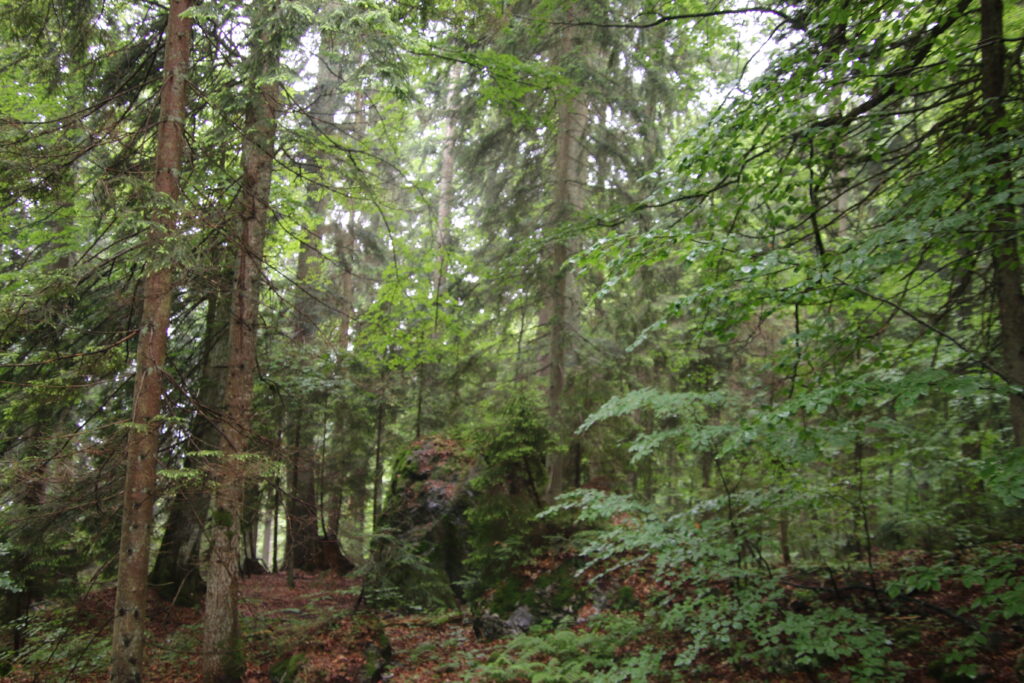
WWF-Romania welcomes the Ministry of Environment, Waters and Forests’ decision to organize a public debate on 30 April regarding the draft Order approving the Methodology for identifying Priority Areas for Biodiversity (PAB). As part of the public consultation process, WWF already submitted, starting last Friday, a series of observations and proposals regarding the Methodology.
We consider this step a necessary and timely opening that can contribute to strengthening a truly participatory process, at a crucial moment for achieving the objectives assumed by Romania through the National Recovery and Resilience Plan (PNRR) and the EU Biodiversity Strategy for 2030. The organization of an applied public debate is welcome for clarifying and improving the Methodology, by integrating technical expertise and stakeholders’ perspectives, so that the final result reflects a balance between protecting the most relevant biodiversity values, ensuring ecological connectivity, and limiting socio-economic impacts.
Important step for Romania’s biodiversity
The process of identifying Priority Areas for Biodiversity represents a major milestone for Romania, with long-term implications for biodiversity conservation and the functioning of the protected areas network.
In this context, we particularly appreciate the directions included in the Methodology regarding:
- the set of aquatic ecosystems with high ecological value – watercourses, wetlands, and riparian forests outside the national forest fund;
- silvo-pastoral (agroforestry) mosaic landscapes – mixtures of grasslands, shrublands, and forests.
These directions support an integrated and necessary approach for the conservation of biodiversity representative of Romania, and their preservation creates the conditions for coherent identification and mapping, in line with the principles of proportionality, representativeness, and ecological connectivity. It is essential to emphasize that, in the case of silvo-pastoral landscapes, responsible grazing and mowing remain compatible and necessary management measures for biodiversity conservation.
A call for dialogue and balanced solutions to improve the Methodology
WWF-Romania will actively participate in the public debate in order to contribute to improving the Methodology, especially with regard to forest ecosystems.
Our analysis shows that the current form of the Methodology risks affecting the very principles it should strengthen – scientific grounding, practical applicability, and ecological and socio-economic sustainability. In particular, we consider it necessary to clarify aspects such as:
- avoiding the conceptual overlap between conservation measures integrated into forest management and the protection regime applied to priority areas for biodiversity;
- maintaining coherence in the identification of old-growth forests and guaranteeing field validation for correct identification;
- introducing real prioritization, taking into account biodiversity values specific at national level, connectivity, and socio-economic impact;
- introducing indicative thresholds in applying the principle of proportionality regarding both habitat types and distribution across biogeographical regions;
- explicitly stating that the identification Methodology applies strictly within the limits of the Investment Project financed through the National Recovery and Resilience Plan, based on Service Contract no. 119/16.08.2023 (I3 – PNRR).
Why this moment matters
We emphasize that the current form of the Methodology for identifying PABs has structural implications for the entire forest management system in Romania, whose effects will be felt immediately and in the long term.
The changes introduced lead to a series of concrete risks:
- undermining close-to-nature silvicultural practices that ensure biodiversity conservation through planned, controlled interventions oriented toward this objective;
- discouraging the application of conservation measures in production forests;
- affecting the credibility of the process of identifying and designating priority biodiversity areas and social acceptance, especially among local communities, of the protected areas regime.
Overall, there is a risk that the results of applying the Methodology, in its current form, may be rather unfavorable to biodiversity, contrary to the objectives of the EU Biodiversity Strategy.
We remain open to constructive dialogue and express our willingness to actively contribute to this process in order to ensure a coherent, sustainable approach adapted to the national context.